Office Clearance: Recycling & Sustainability Commitment
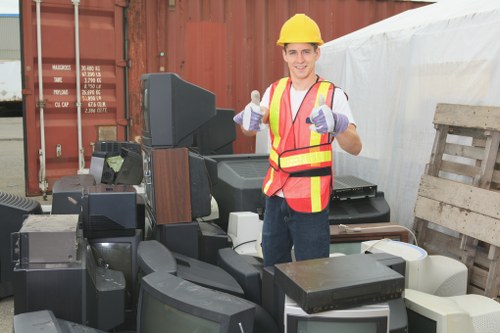 Office Clearance projects present a major opportunity to reduce waste, conserve resources and support local communities. Our office clearance services are built around a clear sustainability strategy: reduce, reuse and recycle as much material as possible while minimising transport emissions. We set a measurable recycling percentage target to hold ourselves accountable and to drive continuous improvement across every commercial and small-business clearance we carry out.
We aim for a 95% recycling and repurposing target of all recoverable materials removed during an office clearance. That target covers paper, cardboard, metals, glass, plastics, textiles and larger items such as furniture and IT equipment. To achieve this we operate detailed sorting at source combined with partnerships with authorised local transfer stations and certified recycling facilities so materials are tracked from site to final processing.
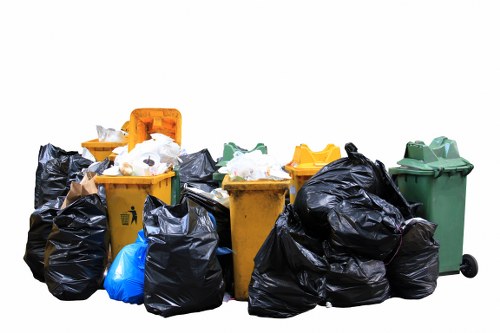
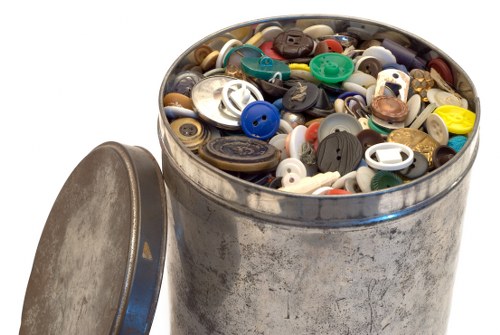 Tackling waste from offices requires understanding local collection practices: many boroughs follow a multi-stream approach with separated paper/cardboard, mixed recycling, glass and sometimes food waste. Our clearance teams adapt to the local borough's approach to waste separation and ensure that office clearances respect municipal stream rules. By aligning with council policies we reduce cross-contamination and increase the volume of material that can be diverted from landfill.
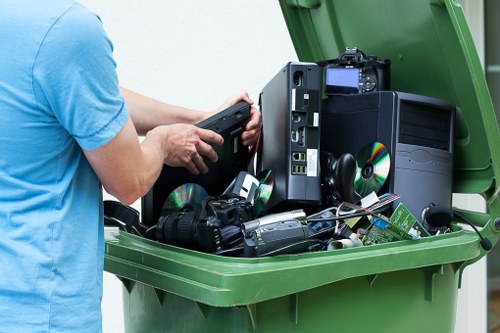
Beyond municipal streams, our office removals and clearance operations prioritise specialised recycling for electrical and electronic equipment (WEEE), lighting (including low-energy lamps), batteries, and toner cartridges. We maintain documented chains of custody when handling WEEE and use authorised collectors to make sure items are processed according to hazardous and e-waste regulations. This approach both protects data security and maximises material recovery from valuable components.
 A core element of our sustainable office clearance offering is reuse. We collaborate with a network of charities and community partners to redistribute usable furniture, fixtures and fittings. Typical partners include local charitable organisations, employment-training centres and community reuse hubs. These partnerships mean desks, chairs, shelving and working IT that are still in good condition get a second life, reducing demand for new products and supporting local social value.
Our commercial office clearance services also include inventory auditing and decommissioning guidance so businesses can plan ahead. By creating a separation plan before removal day, the amount of mixed waste sent to transfer stations is minimised. We document recovered tonnages and produce internal reports to compare against our recycling percentage target and to help clients demonstrate their own sustainability credentials.
 Transport is a major part of our environmental footprint, so we have invested in a fleet of low-carbon vans and optimised routing to minimise mileage. Our vehicles include fully electric vans where available and low-emission hybrids on longer routes, equipped with telematics for efficient scheduling. Using route optimisation software we reduce empty miles and consolidate trips across multiple office clearances, lowering CO2 emissions per job.
To support circular outcomes we make regular drop-offs at authorised local transfer stations and civic amenity sites that prioritise segregation and high-quality processing. These facilities are chosen for their capacity to handle different material streams separately, which improves recovery rates for cardboard, mixed plastics and metals. We also use transfer stations that accept bulky items for reuse processing, allowing charities and reuse organisations to collect items locally.
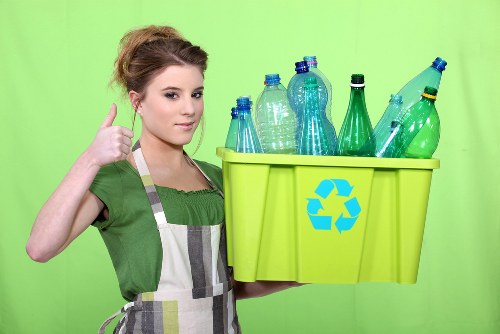 Our sustainability policy for office clearances emphasises transparency and continuous improvement. We publish internal performance targets and monitor year-on-year progress against our 95% recycling goal. Key activities include:
- Audit-led clearances: pre-clearance surveys to maximise reuse potential
- Segregation at source: separating streams on site to improve recycling quality
- Charity partnerships: coordinated collections to deliver high-quality donations
- Low-carbon logistics: electric and hybrid vans plus optimised routing
- Responsible WEEE handling: certified processing partners and data security
Our Local Approach and Community Links
The emphasis we place on local transfer stations and charity networks means our office clearance delivery is adapted to the neighbourhood level. In boroughs where food waste and compostables are separated, our teams work with facilities that can accept the organics stream from office kitchens and staff canteens. In more dense urban boroughs that prioritise dry recycling streams, we focus efforts on maximising separate collections for paper, card and mixed plastics.
Measuring Impact and Future Commitments
We measure impact through weight-based recovery reports, percentage recycled calculations and records of donations made to partner charities. Strong governance ensures every office clearance job follows a standard operating procedure that favours reuse first, recycling second and disposal only as a last resort. Looking ahead, we are exploring additional investments in fully electric transport, on-site deconstruction services to increase salvage rates and expanded charity partnerships to broaden reuse pathways.
By choosing our office clearance and office clearance services, organisations can be confident their surplus assets and waste are handled responsibly ??? aligned to local borough recycling practices, supported by low-carbon vans, routed via authorised transfer stations and redirected to charities where possible. Our integrated approach turns clearance into an opportunity: reducing landfill, lowering carbon emissions and delivering positive outcomes for local communities.